 UK Schools
Dallam School
Dallam School is a mixed secondary academy in Cumbria, Westmorland and Furness Council, teaching 761 pupils aged 11 to 18. Ofsted graded achievement as Needs attention at its most recent inspection in April 2026. In 2024–2025, GCSE Attainment 8 was 44.1 (England 46.1). Term dates and holidays for 2025–2026 are listed below.
Ofsted inspection
The latest published Ofsted judgement for Dallam School.
Scale: Exceptional Strong standard Expected standard Needs attention Urgent improvement
Term dates & holidays 2025–2026
Autumn, spring and summer terms, half-terms, INSET days and bank holidays for Dallam School.
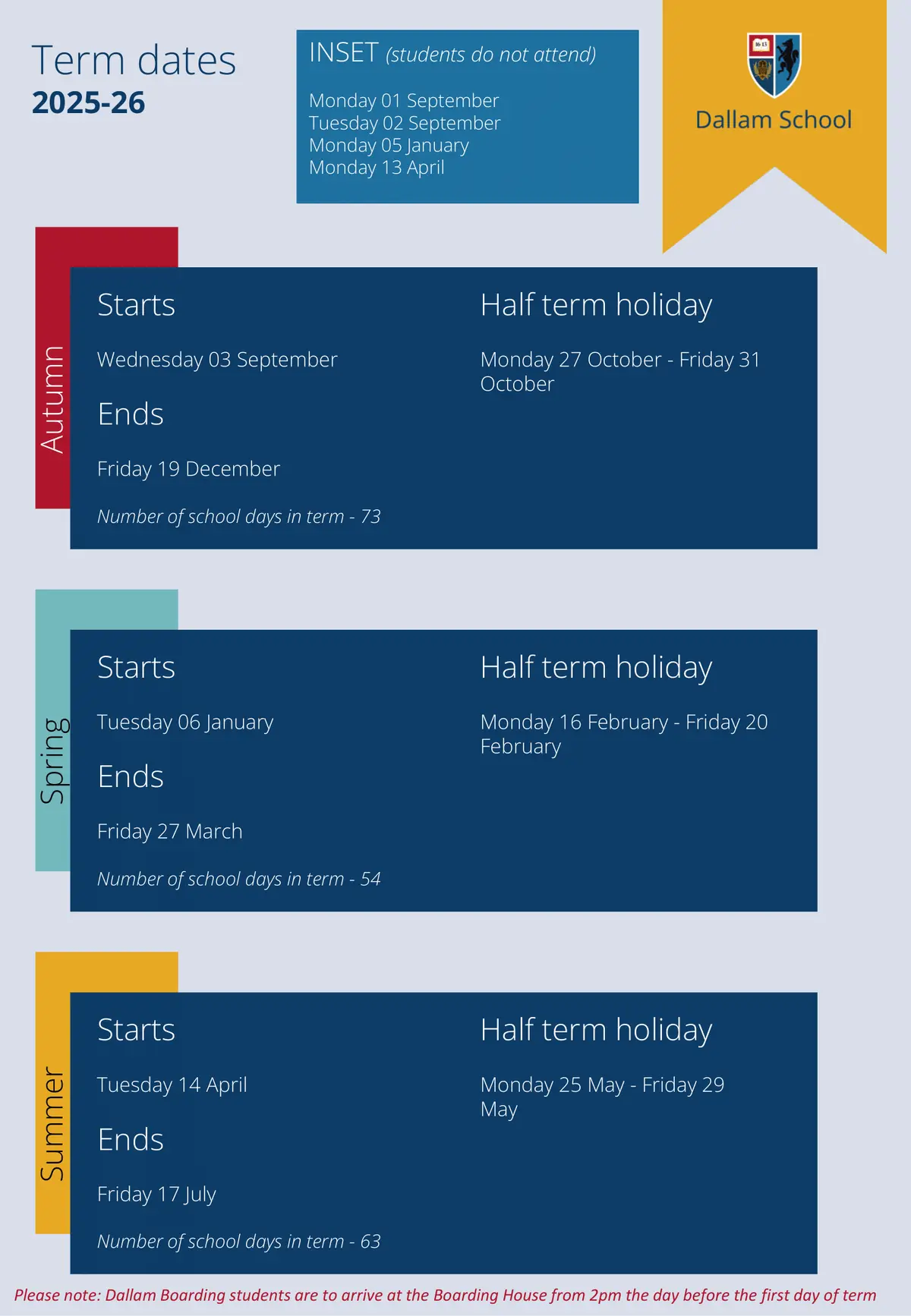
Key dates (2025–2026)
- Inset Day (students do not attend) Monday 01 September 2025 Inset Day
- Inset Day (students do not attend) Tuesday 02 September 2025 Inset Day
- Autumn Term Wednesday 03 September 2025 - Friday 19 December 2025 Term
- Autumn Half Term Holiday Monday 27 October 2025 - Friday 31 October 2025 Holiday
- Inset Day (students do not attend) Monday 05 January 2026 Inset Day
- Spring Term Tuesday 06 January 2026 - Friday 27 March 2026 Term
- Spring Half Term Holiday Monday 16 February 2026 - Friday 20 February 2026 Holiday
- Inset Day (students do not attend) Monday 13 April 2026 Inset Day
- Summer Term Tuesday 14 April 2026 - Friday 17 July 2026 Term
- Summer Half Term Holiday Monday 25 May 2026 - Friday 29 May 2026 Holiday
- Christmas Holiday Saturday 20 December 2025 - Monday 05 January 2026 Holiday
- Easter Holiday Saturday 28 March 2026 - Monday 13 April 2026 Holiday
- Summer Holiday Saturday 18 July 2026 - Early September 2026 Holiday
- New Year's Day Thursday 01 January 2026 Event
- Good Friday Friday 03 April 2026 Event
- Easter Monday Monday 06 April 2026 Holiday
- Early May Bank Holiday Monday 04 May 2026 Holiday
- Spring Bank Holiday Monday 25 May 2026 Holiday
- Summer Bank Holiday Monday 31 August 2026 Holiday
- Christmas Day Friday 25 December 2026 Holiday
- Boxing Day Saturday 26 December 2026 Event
Exam results & performance
The measures that carry the most signal. Open a section to compare Dallam School with Westmorland and Furness Council and England.
Key stage 4 (GCSE) 44.1 Attainment 8 score
Year 11 results across eight qualifications, including English and maths.
This school Westmorland and Furness Council England
16 to 18 (A level & sixth form) 31.91 A level average point score
Results for students finishing post-16 study.
This school Westmorland and Furness Council England
Attendance 25.3% Persistently absent pupils
Absence across the whole school year.
This school Westmorland and Furness Council England
What pupils do after GCSEs 96% In education, apprenticeship or work
Still in education, an apprenticeship or work a year after key stage 4.
This school Westmorland and Furness Council England
What students do after 16 to 18 study 82% In education, apprenticeship or work
Destinations the year after finishing post-16 study.
This school Westmorland and Furness Council England
About this data source & caveats
Progress 8 is not published for 2024–2025. This year group missed their key stage 2 tests in 2020, so there is no baseline to measure progress from.
Attendance comparisons are pupil-weighted averages we calculate from every school’s published absence figure — the DfE absence file has no local authority or England rows of its own.
We show the headline measures only. Threshold and curriculum-policy figures — grade 4+ in English and maths, EBacc entry and points, the per-subject key stage 2 breakdown, academic and applied splits at 16 to 18 — reflect admissions and curriculum choices more than school quality, so they are left to GOV.UK. Progress measures matter most because they compare pupils with others who started at the same level; attainment on its own largely tracks a school’s intake.
Figures are the Department for Education’s official published results for Dallam School. Results are suppressed where too few pupils were entered. England figures are the average for state-funded schools. “Top x%” is this school’s position among all schools in England with a published figure for that measure — the DfE does not publish league table rankings.
Source: Compare school and college performance, Department for Education. Contains public sector information licensed under the Open Government Licence v3.0.
Location & catchment area
Indicative only. This is a nearest-school (Voronoi) estimate — the area closer to Dallam School than to any other secondary school. Real admissions depend on the school’s own policy (straight-line distance, siblings, faith, feeder schools and available places) and change each year. Always confirm with the school and local authority admissions team.